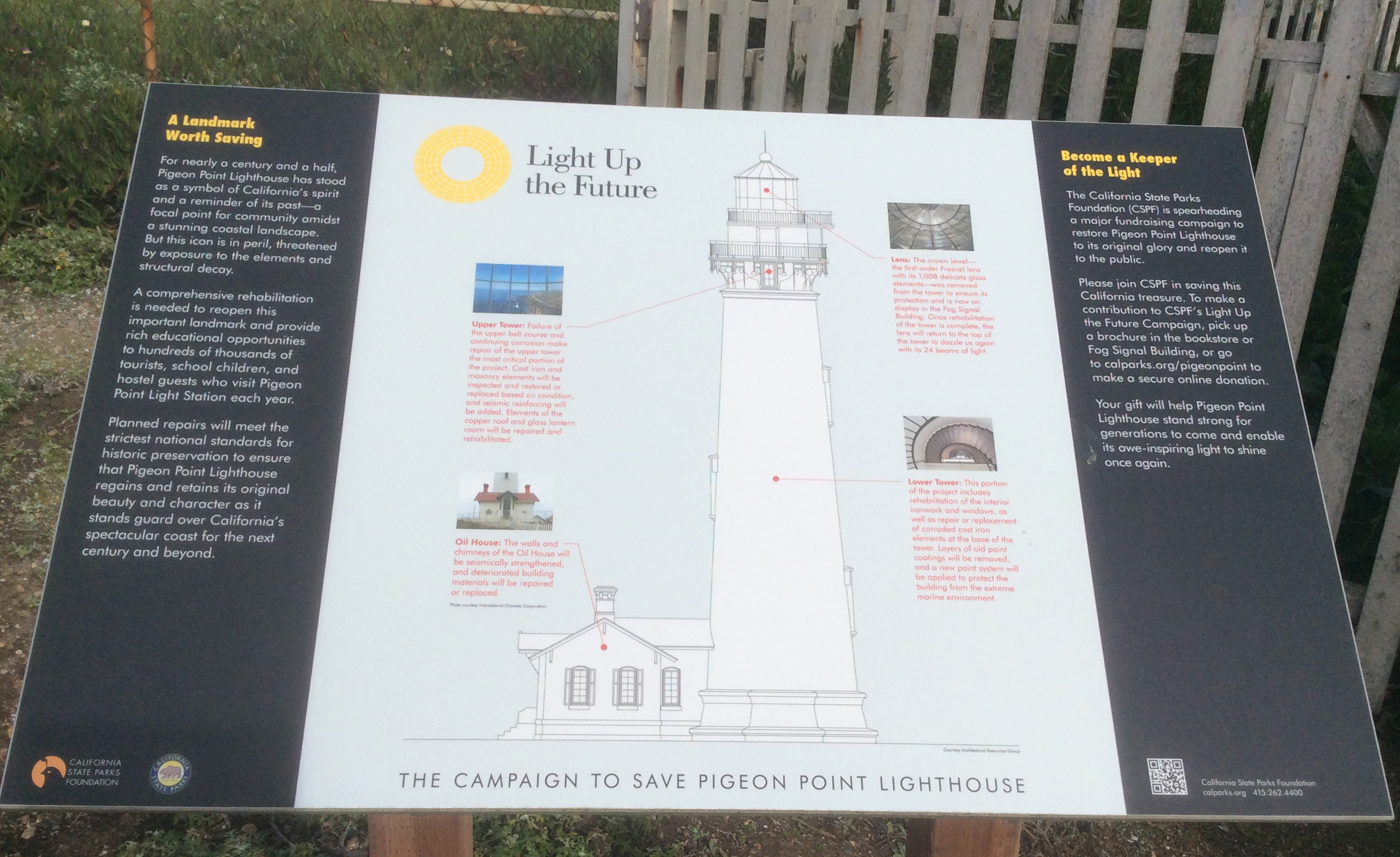
There are continual questions regarding the status of the Pigeon Point Light House tower restoration project. This article describes some of the history as well as the current status.
Background
In 1980 the Department of Parks and Recreation (DPR) leased Pigeon Point Light Station from the U.S. Coast Guard and operated it as a park. In December 2000 a piece of the cast iron band that gave the tower its structural integrity fell to the ground. This resulted in the tower being closed to the public early in 2001. It has remained closed ever since.
The transfer of the property to the State of California was a protracted process that started in 2005. When the DPR received title to Pigeon Point Light Station in 2011, the California State Park Foundation had signed up to the task of fundraising for the restoration project.
 First phase was removing the Fresnel lens
 Most important are the structural repairs
The Project Starts
The first project the Foundation funded was removing the Fresnel lens from the lantern room and reassembling it in the Fog Signal Building for preservation and interpretation. More people will see the lens in its current location, and it helps us to tell the story of the restoration process. The intention is to return the lens to the lantern room when the tower is structurally stable.
The next step was creating the Historic Structures Report; a vital element to understanding the building and the changes that had been made over time. The plan is to restore the building to a historical point in time.
The Foundation continued its work with stabilization of the cast iron band, sealing bricks and windows, and a Rehabilitation plan for the restoration process. It identified several areas that need work and came up with a multi-phased plan. Interpretive signs that describe the restoration project were installed around the site, and a donor-recognition board was placed inside the Fog Signal Building. The Upper Tower is the most critical part of the project. As its sign says, “Cast iron and masonry elements will be inspected and restored or replaced based on condition, and seismic reinforcing will be added.”
Next, the Foundation funded the preparation of the architectural drawings that will be used to restore the structure. This was the last step needed to get permits and start the real fundraising push.